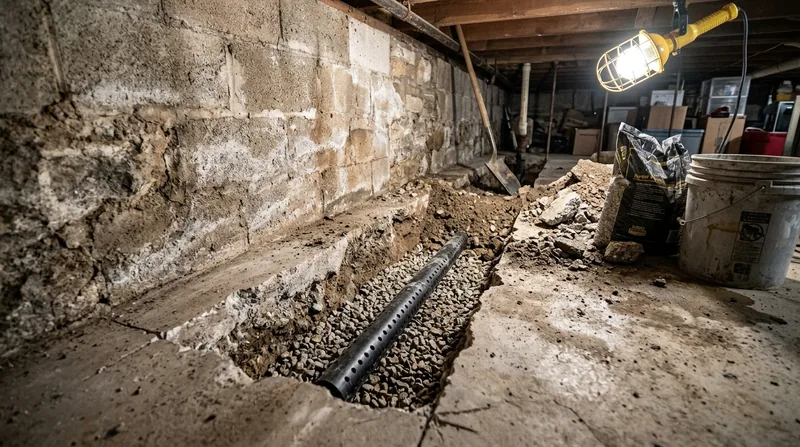




Interior Drain Tile System in Dayton: Stop Water at the Footing, Not at the Wall
Dayton sits on glacial till and river-deposited silt and clay over limestone bedrock, and the Great Miami and Mad rivers keep the water table shallow in the river bottoms. That geology is why so many full basements in the Oregon District, Wright-Dunbar and Old North Dayton weep after an April storm: the soil holds water against stone, brick and early block walls, and old clay footing drains have long since collapsed or silted shut. An Interior Drain Tile System in Dayton captures that water at the slab edge, channels it to a sump basin and pumps it out, so hydrostatic pressure never gets the chance to push through the wall. We install these systems year-round because the work happens inside, below the slab, regardless of what the sky is doing. If you are weighing this against excavation, start with a basement waterproofing assessment and we will tell you straight which approach your foundation actually needs.
Why Dayton Basements Need Interior Drainage, Not Just Crack Sealing
Freeze-thaw winters work every crack in a 1920s brick bungalow in Belmont or South Park, and spring thaw pushes meltwater down through the same silt and clay that drains slowly on a good day. When the water table rises in the river bottoms, water arrives under the footing from below and the pressure shows up as seepage at the cove joint, efflorescence on the block, and a musty basement smell by June. Sealing a crack is the right call when the crack is the whole problem; an interior perimeter drain is the right call when the problem is water volume under the slab.
- Your basement seeps along the wall-floor joint after heavy rain, which points to hydrostatic pressure rather than a single failed crack.
- Old clay footing drains around pre-war homes have collapsed or filled with silt and no longer carry water away from the wall.
- You have patched cracks and sealed walls more than once, and water still finds a new path every spring.
- 1950s to 1970s ranches in Kettering, Centerville and Huber Heights have daylight or partial basements where water pools at the low wall.
- Your sump pump runs constantly during June thunderstorms and you need a system that feeds it reliably.
If two or more of those describe your basement, interior drainage is doing more work than any surface sealer can.
Key info: A homeowner in Old North Dayton had water crossing the floor every April and had already paid twice for crack sealing. The cracks were real, but the water was arriving under the footing from saturated glacial clay. Interior drain tile along the perimeter plus a properly sized sump basin ended the flooding, and the crack repair we did afterward had a chance to hold.
Permits for work that alters drainage or the sanitary connection of a sump discharge vary by jurisdiction, so confirm requirements with the City of Dayton building department before work starts. You can check the city's permit information at daytonohio.gov.
How We Install an Interior Drain Tile System in Dayton Homes
Every installation starts with a free basement inspection, because the right system depends on wall type, footing depth and where the water is actually entering. We map the seepage, check the existing drain tile if there is any, and confirm whether the sump discharge can be routed legally. Then we cut, lay pipe and restore, in that order, with dust control running the whole time.
- We break and remove a channel of slab, roughly 12 inches wide, around the interior perimeter.
- We dig down to the footing and true up the trench so the pipe sits at a consistent fall.
- We set perforated drain tile in washed stone, with filter fabric to keep silt out of the pipe.
- We tie the perimeter run into a new sump basin set at the low point of the basement.
- We install the sump pump, check valve and discharge line, then test the system with water before closing anything up.
- We pour new concrete over the trench and leave the floor ready to use.
Most homes are back to normal use the same week, and the system works the same in January as it does in July.
Key info: In a 1960s split-level in Huber Heights, the low corner of the basement took on water every time the ground thawed. We ran interior drain tile along the two wet walls, tied it to a new basin, and added a battery backup sump pump because the neighborhood loses power in summer storms. The floor has stayed dry through two spring thaws since.
Interior Drain Tile Compared to Other Approaches
Interior drainage is not the only tool, and it is not always the right one. Here is how the main approaches compare on Dayton foundations.
| Approach | Description | Best for |
|---|---|---|
| Interior perimeter drain tile | Pipe under the slab edge at the footing, feeding a sump basin and pump. | Water arriving under the footing and seeping at the cove joint. |
| Exterior footing drain replacement | Excavation to the footing, new drain tile and waterproof membrane on the wall. | Failed original footing drains where excavation is practical. |
| Crack injection | Epoxy or polyurethane injected through ports to close a specific crack. | Isolated non-moving cracks in poured walls. |
| Wall sealing and vapor barrier | Surface sealing and moisture control on the interior wall face. | Damp walls and humidity control, not standing water. |
| Drain tile repair | Clearing or replacing a failed existing interior or exterior drain run. | Systems that were installed correctly but have silted or collapsed. |
We will tell you when a simpler repair is enough, and when hydrostatic pressure means only drainage will solve it. For homes in the 45405 and 45429 ZIP codes, see our local pages for Dayton 45405 and Kettering 45429.
Interior Drain Tile System Cost in Dayton: What to Expect
Interior drain tile is priced by the linear foot of perimeter, so the size and shape of your basement drives most of the number. Our starting point is From $50 per linear foot, which covers breaking and removing the slab, trenching to the footing, washed stone, filter fabric, perforated pipe, and pouring new concrete over the run. A typical full-perimeter job on a Kettering ranch lands well above the minimum because the run is long.
What moves the price up: a full basement versus a partial one, thick or reinforced slab that takes longer to cut, a stone or brick rubble wall that needs extra care at the footing, tight access through a finished basement, and whether a new sump basin, pump and discharge line are included. Homes in Beavercreek and Vandalia with poured walkout basements on sloped lots often need a different basin location and a longer discharge run, which adds labor.
Get two or three written estimates and compare scope, not just the total. Ask whether the price includes the sump pump, the discharge line and concrete restoration, because a low bid that excludes them is not a low bid. Our full pricing overview breaks down the line items.
Interior Drain Tile System Near Me: How to Choose a Dayton Contractor
Searching for an interior drain tile system near me in Dayton returns plenty of names, and the differences between them matter more than the ads suggest. Interior drainage is below-grade work that touches your slab and your foundation, so the contractor needs to be licensed and insured, and should be able to show you a certificate before you sign anything. Ask for references from jobs in your part of town, especially older homes with stone or brick walls.
Confirm who pulls the permit if one is required for the drainage or sump discharge work, and check with your local building department because rules vary by jurisdiction. If your neighborhood has HOA requirements, get them in writing before the crew shows up. A contractor who welcomes those questions is the one you want. Reach us through our contact page to schedule a free inspection.
Water in a Dayton basement is almost always a drainage problem before it is a wall problem. Call (937) 818-4090 and we will inspect the basement, explain what the water is doing, and give you a written scope with a transferable warranty.
Interior Drain Tile System in Dayton: Pricing Guide
| Service | Price | Details |
|---|---|---|
| Interior perimeter drain tile, partial run | Starting at $50/linear ft | Includes slab cutting, trenching to footing, stone, filter fabric, perforated pipe and concrete restoration on one or two walls |
| Interior perimeter drain tile, full basement | Starting at $50/linear ft | Full perimeter run with new sump basin tie-in; total scales with linear feet and wall type |
| Sump basin, pump and discharge package | On estimate | Basin, pump, check valve and discharge line priced with the drain run; discharge routing and local code affect the number |
| Rubble stone or brick wall footing work | On estimate | Older Dayton homes need hand work at the footing and extra care not to undermine the wall |
| Travel | Included | In Dayton and surrounding areas, no separate call-out or mileage fee |
| Estimate | Free | Response within 24h at (937) 818-4090, no obligation to book |
Indicative pricing, the exact cost depends on square footage, finish, and site access. Free personalized estimate within 24h at (937) 818-4090.


