



Bowing Wall Repair in Dayton: Stop the Lean Before It Spreads
If you own an older home in Dayton, chances are your basement wall has already told you a story. The brick and stone walls under the Oregon District, Wright-Dunbar and Old North Dayton houses were laid when horse-drawn clay tile was the standard for footing drains, and a century of glacial clay pressure has pushed many of them out of plumb. When a wall leans inward, bulges at mid-height or shows a horizontal crack running the length of a block course, you are looking at a structural symptom that will not correct itself. Bowing Wall Repair in Dayton means reading that symptom honestly, measuring how far the wall has moved, and choosing a stabilizer that matches the load your soil actually puts on it. Our work is strictly below grade: we assess the pressure, the wall and the drainage together, then install carbon fiber straps, steel I-beams or wall anchors to stop the movement. If you want the wider context first, start with our basement waterproofing overview and we will walk the foundation with you.
Why Dayton Basement Walls Bow: Glacial Clay, Old Block and Spring Thaw
The ground here is glacial till and river-deposited silt and clay over limestone bedrock, and the Great Miami and Mad river bottoms keep a shallow water table. Clay swells when it takes on water and pushes laterally against the wall, which is hydrostatic pressure in plain terms. The city's older housing stock makes this worse: full basements with stone, brick or early block walls, original clay footing drains that have long since silted shut, and freeze-thaw winters that open cracks a little wider every year.
- Homes in Belmont and South Park from the 1920s to 1950s often show mid-wall bulging after a long wet spring, because the original weeping tile no longer carries water away from the footing.
- Brick and early block walls in Old North Dayton crack horizontally when the clay load exceeds what the mortar bed can resist.
- 1950s to 1970s ranches and split-levels in Kettering and Huber Heights were built with thinner block courses and can lean noticeably after repeated April and June storm cycles.
- Poured walkout basements on the sloped lots in Beavercreek and Vandalia bow less often, but they can rotate where backfill was never compacted properly.
Each of these failure modes calls for a different stabilizer, and guessing wrong wastes money and leaves the wall moving.
Key info: On a 1920s brick basement wall in South Park, a horizontal crack at mid-course plus inward lean of an inch or more is the classic signature of saturated clay pressing on a wall whose footing drain is dead. That is a stabilization call, not a crack-sealing call.
Structural repair permits in Ohio are administered locally, so always confirm requirements with the City of Dayton's building department before work begins: City of Dayton official site.
How We Diagnose and Stabilize a Bowing Wall in Dayton
We start by measuring, not guessing. A plumb line and a laser level tell us how far the wall has moved and where the pivot point sits. We then check the footing drain condition, the grading around the foundation and the downspout discharge, because a wall that keeps taking water will keep moving even after it is braced. Only then do we match the repair to the severity.
- We inspect the full wall from the inside, note crack orientation and measure deflection at three heights.
- We check whether hydrostatic pressure is still active by looking for efflorescence, damp block and water staining at the base.
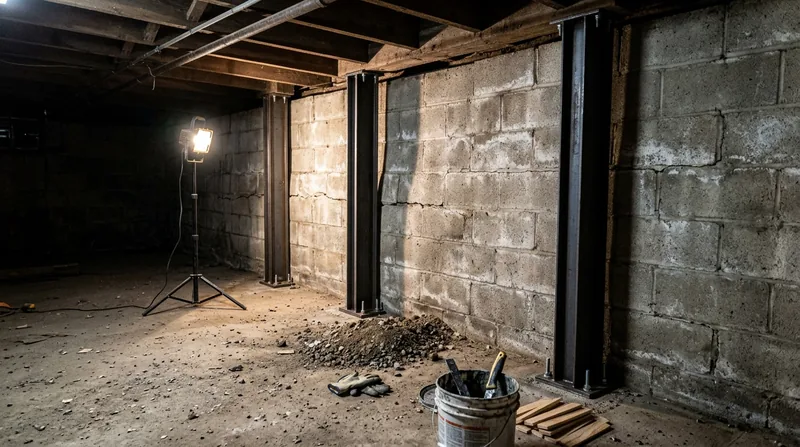
- We recommend carbon fiber straps for walls with limited movement, steel I-beams for heavier loads, or wall anchors where the wall must be pulled back toward plumb.
- We correct the water source with an interior perimeter drain or footing drain repair so the stabilizer is not fighting a wet wall.
- We document the before and after measurements so you can see the wall is holding.
The order matters: bracing a wall that still sits in saturated clay is a temporary fix at best.
Local example: A split-level in Centerville had a block wall leaning about 1.5 inches after a wet June. Carbon fiber straps on the interior face plus a interior drain tile system to relieve the pressure stopped the movement and kept the floor dry through the next spring thaw.
Matching the Repair to the Wall: Methods We Use
No single method fits every bowing wall. The table below shows how we choose between them, based on deflection, wall material and how much water the soil is holding.
| Approach | Description | Best for |
|---|---|---|
| Carbon fiber straps | High-strength straps bonded vertically to the interior wall face and anchored top and bottom. | Block walls with moderate bowing and no need to pull back to plumb. |
| Steel I-beams | Vertical steel beams set against the wall and tied into the floor and joist system. | Heavier loads, deeper bowing, or walls that need rigid restraint. |
| Wall anchors | Exterior anchor plates connected through the wall to interior plates, tightened to draw the wall back. | Walls that have rotated outward and can be straightened incrementally. |
| Drainage correction | Interior perimeter drain, footing drain repair or grading changes to remove the water pressure. | Any bowing wall where saturated clay is the driving cause. |
In most Dayton homes the right answer combines a stabilizer with drainage work, and we tell you plainly when a simple crack seal is enough instead.
Bowing Wall Repair Cost in Dayton: What to Expect
Cost depends on how far the wall has moved, how long it runs, what the wall is made of and whether drainage work is needed alongside it. A single carbon fiber strap installation on a short block wall can start around $600, while a full wall of steel beams or anchors on a long basement wall runs into the thousands. We quote after measuring, never over the phone.
Getting two or three estimates is smart on this kind of work, because the diagnosis matters as much as the price. Ask each contractor how they measured the deflection and whether they addressed the water pressure. Our full pricing overview lays out the ranges we work within.
Hiring a Bowing Wall Repair Contractor Near Me in Dayton
Ask for proof of licensing and insurance before anyone touches your foundation, and get a written scope that names the method and the measurements. Check references from jobs in older Dayton neighborhoods where stone and block walls are common, since poured-wall experience alone does not transfer. Confirm who pulls the structural permit, because rules vary by jurisdiction and the local building department has the final word.
If your home sits in a historic district, check any additional review requirements before work starts. When you are ready to talk, contact us for a free estimate and we will walk the basement with you.
Key info: A bowing wall rarely fails overnight, but it does not reverse either. The earlier the measurement is taken, the more options you have, and the less likely the repair escalates from straps to beams.
Bowing Wall Repair in Dayton: Pricing Guide
| Service | Price | Details |
|---|---|---|
| Carbon fiber strap installation | Starting at $600 | Covers measuring deflection and bonding straps to a short block wall section. |
| Steel I-beam stabilization | Starting at $1,800 | Includes beam setting and tie-in; wall length and load drive the price up. |
| Wall anchor system | Starting at $2,500 | Exterior anchor plates and incremental tightening; access and wall length move the number. |
| Drainage correction alongside repair | On estimate | Interior drain or footing repair priced after we see how wet the soil stays. |
| Estimate | Free | On-site measurement and written scope at (937) 818-4090, no obligation. |
Indicative pricing, the exact cost depends on square footage, finish, and site access. Free personalized estimate within 24h at (937) 818-4090.


