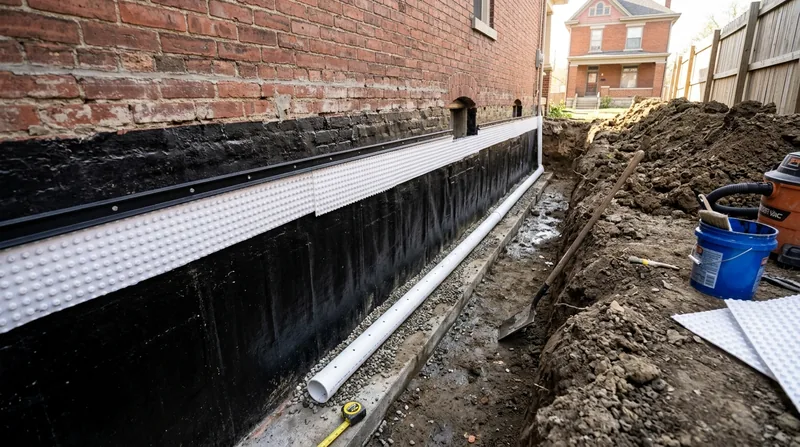




If you live in one of Dayton's older neighborhoods, like the Oregon District, Wright-Dunbar or Old North Dayton, you know the pattern: every spring thaw and every heavy April or June storm sends water through stone, brick or early block walls that were never meant to hold back a saturated water table. Exterior Basement Waterproofing in Dayton is the below-grade fix that stops that water at the outside face of the foundation, where it starts. We excavate down to the footing, apply a waterproof membrane or dimple board directly to the wall, correct the grading and extend the downspouts so storm water leaves the house instead of soaking into glacial clay soil. This is the most thorough approach for a wall that seeps season after season, and it is done once. If you are still deciding between approaches, start with our basement waterproofing overview before you commit to excavation.
Why Exterior Basement Waterproofing Matters in Dayton's River Valleys and Old Brick Neighborhoods
Dayton sits on glacial till and river-deposited silt and clay over limestone bedrock, and the Great Miami and Mad rivers run right through the region with a shallow water table in the river bottoms. That combination is hard on foundations. The 1913 flood reshaped the city's river defenses, but it did nothing for the private footing drains under homes built in the 1900s through the 1950s, many of them old clay tile that has long since collapsed or clogged. Add freeze-thaw winters that work cracks open every year, and you get the seepage pattern we see across Belmont, South Park, Kettering and Huber Heights.
- Hydrostatic pressure pushes water through porous brick, stone and early block walls that were never damp-proofed.
- Failed clay footing drains cannot carry water away, so it backs up against the foundation instead of draining.
- Grading that slopes back toward the house funnels roof and surface water into the same wall.
- Short downspouts dump thousands of gallons next to the foundation during a single summer thunderstorm.
When those four problems stack up, patching the inside of the wall only hides the symptom. The water is still in the soil, still under pressure, and still finding the mortar joints.
Key info: In the Oregon District and Old North Dayton, we routinely find original clay footing drains that have not moved water in decades. On those blocks, exterior excavation with a new drain and membrane is usually the honest answer, not another interior patch.
Permits for work that alters drainage or the sanitary connection of a sump discharge vary by jurisdiction, so confirm the requirements with the City of Dayton building department or your local jurisdiction before work begins. You can review the city's permit information at daytonohio.gov.
How We Do Exterior Basement Waterproofing in Dayton, Step by Step
Exterior work is excavation work, and the sequence matters more than the materials. We start by locating utilities, then hand-dig and machine-dig in controlled passes so we do not disturb the footing or the adjacent grade. On the sloped walkout lots in Beavercreek, Vandalia and Springboro, we often only need to expose the uphill wall, which keeps the dig smaller and the cost lower than a full perimeter job.
- We mark utilities and confirm the scope with you before any soil is moved.
- We excavate down to the footing, typically 6 to 8 feet, and keep the spoil clear of the work area.
- We clean and parge the wall to give the membrane a sound surface.
- We apply a waterproof membrane or dimple board directly to the foundation wall.
- We install or repair the footing drain and tie it into the sump system where one exists.
- We backfill with free-draining material and correct the grading so the slope runs away from the house.
- We extend downspouts well past the backfill and test the system before we leave.
Every step is inspected before the next one covers it, because once the soil goes back in, the only way to fix a mistake is to dig it out again.
Local example: A 1920s brick bungalow in South Park had water crossing the basement floor every March. The footing drain was crushed clay tile and the downspouts ended at the wall. We excavated the uphill side, installed dimple board and a new footing drain, and extended the downspouts 8 feet out. The basement has stayed dry through the last three spring thaws.
If your foundation has moved as well as leaked, read our foundation waterproofing page before we dig, since bowing or settling changes the plan.
Exterior vs Interior: Which Approach Fits Your Dayton Basement
Not every wet basement needs excavation. If the water is coming through a single vertical crack in a poured wall, epoxy or polyurethane injection is faster and cheaper. If the wall is dry but the floor is wet at the cove joint, an interior perimeter drain with a sump basin often solves it without digging outside. Exterior work is the right call when the wall itself is saturated, when the footing drain has failed, or when you want the problem solved from the soil side.
| Approach | Description | Best for |
|---|---|---|
| Exterior membrane and footing drain | Excavate to the footing, apply membrane or dimple board, replace the drain | Saturated walls, failed clay footing drains, old brick and block |
| Crack injection | Epoxy or polyurethane injected through ports into a single crack | Isolated vertical cracks in poured walls, no wider pressure problem |
| Interior perimeter drain | Interior drain tile along the footing inside, feeding a sump basin | Water at the floor joint, wet slab, no wall saturation |
| Grading and downspout correction | Regrade the soil and extend discharge lines away from the wall | Surface water reaching the foundation, early seepage |
We tell you plainly which one your basement needs, even when the smaller job is the right one. If the diagnosis points inside, our interior drain tile system page covers that route.
Exterior Basement Waterproofing Cost in Dayton: What to Expect
Most exterior jobs in Dayton start at From $95/linear ft, and that figure reflects the real labor and material of digging to the footing, not a teaser rate. The final number depends on how many linear feet of wall we expose, how deep the footing sits, and whether the dig is open on all four sides or tight against a driveway or neighbor's property line. Access is the biggest swing factor on the older lots in Belmont and South Park.
- Linear footage of wall exposed, since a single side costs far less than a full perimeter.
- Depth to the footing and soil type, with river-bottom silt and clay slower to dig than sandy fill.
- Access for equipment, including tight side yards and mature trees near the foundation.
- Whether a new footing drain and sump tie-in are part of the scope.
- Disposal of spoil and any concrete or walkway that has to come out and go back.
Get two or three written estimates on the same scope so you compare like with like, not a full exterior job against a patch. Our full pricing overview breaks down the ranges by scope.
Exterior Basement Waterproofing Near Me: How to Choose a Contractor Near Dayton
Hiring for below-grade work is different from hiring for a above-ground repair, because the mistakes are buried. Ask for proof of license and insurance before anyone puts a shovel in the ground, and get it in writing that the company carries general liability and workers' compensation. Ask for references from jobs in your own part of town, because a contractor who knows Kettering's 1950s ranches also knows what to expect under a Beavercreek walkout lot.
- Confirm the license and ask for a certificate of insurance naming the coverage limits.
- Get at least three written estimates that describe the same scope of work.
- Check references and ask to see photos of completed excavations and finished walls.
- Ask who pulls the permit and confirm drainage or sump discharge requirements with the local building department.
- Read the warranty terms and confirm they are transferable, not just verbal.
When you are ready to talk, reach us through the contact page and we will set up a free basement inspection.
Exterior Basement Waterproofing in Dayton: Pricing Guide
| Service | Price | Details |
|---|---|---|
| Single wall exterior waterproofing | From $95/linear ft | Excavation to footing, membrane or dimple board, and grading correction on one side |
| Two or three wall exterior waterproofing | From $95/linear ft | Same scope across multiple walls, with per-foot rate holding as footage increases |
| Full perimeter exterior waterproofing | On estimate | Four-wall excavation, new footing drain and sump tie-in need an on-site look first |
| Footing drain replacement add-on | From $28/linear ft | New perforated drain and gravel alongside the existing membrane work |
| Travel | Included | in Dayton and surrounding areas, no separate call-out or mileage fee |
| Estimate | Free | Response within 24h at (937) 818-4090, no obligation to book |
Indicative pricing, the exact cost depends on square footage, finish, and site access. Free personalized estimate within 24h at (937) 818-4090.


