



Foundation Waterproofing in Dayton: Built for Glacial Clay and Old Stone Walls
When you need Foundation Waterproofing in Dayton, the ground under your house matters more than any brochure. Dayton sits on glacial till and river-deposited silt and clay over limestone bedrock, and the Great Miami and Mad rivers keep the water table shallow in the bottoms. That clay holds water against your foundation instead of draining it away. Add spring thaw, heavy April and June storms, and a freeze-thaw cycle that works every crack open a little wider each winter, and you get the seepage pattern we see across the city.
The building stock makes it worse. Oregon District and Old North Dayton homes from the 1900s to 1920s sit on full basements with stone, brick, or early block walls and clay footing drains that have been silting up for a century. Belmont and South Park bungalows from the 1920s to 1950s have full basements with brick walls that spall and chalk. Kettering, Centerville, and Huber Heights ranches from the 1950s to 1970s have daylight or partial basements on sloped lots. Newer Beavercreek, Vandalia, and Springboro subdivisions have poured walkouts where hydrostatic pressure finds the cold joint. We match the fix to the wall, not the other way around. Start with a free basement inspection and we will tell you what your wall is actually doing.
Why Foundation Waterproofing Matters in Dayton's River Bottoms and Clay Soil
Most wet basements in Dayton are not a mystery. Water is being pushed, not falling. Hydrostatic pressure from saturated glacial clay forces moisture through mortar joints in stone walls, through the porous face of brick, and through hairline cracks in poured walls. The 1913 flood reshaped the city's river defenses, but it did nothing about the shallow water table under the river bottoms, and that is what keeps sump pumps running in Riverside and West Carrollton every April. The failure modes we find most often:
- Stone and brick walls in Old North Dayton wick water and show efflorescence as white salt bloom on the interior face.
- Clay footing drains under 1920s Belmont homes are collapsed or root-filled, so water backs up against the footing instead of running to the storm.
- Poured walls in Beavercreek and Vandalia crack at the cold joint and at form ties, and the crack weeps after every heavy rain.
- Downspouts dump at the corner of the house and grading slopes back toward the wall, feeding the same clay that is already saturated.
None of these fix themselves, and sealing the inside face of a wall that is holding back saturated clay is a cosmetic move that fails by the next spring thaw.
Key info: A 1918 brick basement wall in Wright-Dunbar and a 2004 poured wall in Springboro fail for different reasons. The brick wall needs repointing and parging with a breathable mortar so moisture can escape, while the poured wall needs crack injection and drainage. Using the poured-wall fix on the brick wall traps moisture and spalls the brick face.
Permits for structural foundation repair, egress window cutting, and any work that alters drainage or the sanitary connection of a sump discharge vary by jurisdiction. Always verify current requirements with the local building department before work starts. You can check the City of Dayton's permit information at daytonohio.gov.
How We Waterproof a Dayton Foundation, Step by Step
We start below grade and work outward. The first visit is diagnostic: we read the wall type, map where water enters, check the footing drain if it is accessible, and test the grading and downspout discharge. Then we price the least invasive fix that actually solves the problem. Sometimes that is crack injection alone. Sometimes it is an interior perimeter drain because the exterior is a mature tree, a driveway, or a neighbor's property line and excavation is not practical. We say which one and why. If you want the full picture of interior options, see our interior drain tile system page.
- We inspect the basement, the exterior grade, and the downspouts, and we identify the wall type and the entry points.
- We correct grading and extend downspouts so roof water leaves the foundation zone.
- We repair cracks by epoxy or polyurethane injection with injection ports set along the crack.
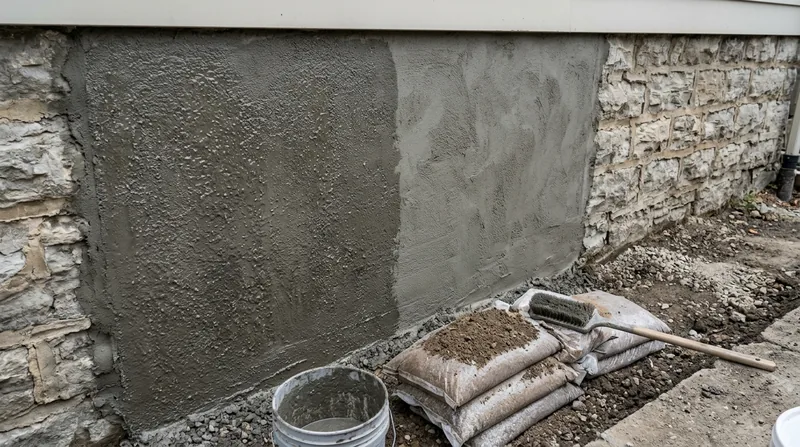
- We repoint and parge stone and brick walls with period-appropriate mortar, then apply a breathable waterproof membrane or crystalline treatment matched to the substrate.
- We install an interior perimeter drain into a sump basin with a check valve and a discharge line that meets local code, and we add battery backup where the pump is the only line of defense.
- We test the system with water before we close up, and we walk you through what to watch for.
Every step is documented so you know what was done and why.
Key info: On a 1954 brick bungalow in South Park, the wall was chalky and weeping at the mortar joints but the footing drain still ran. We repointed, parged with a breathable mix, injected two vertical cracks, and extended the downspouts. No excavation, no interior drain, and the wall stayed dry through the next June storm cycle. On a 1998 walkout in Beavercreek with a saturated slope, injection alone would have failed, so we ran an interior perimeter drain to a new sump basin.
Waterproofing Methods We Use on Dayton Foundations
The right method depends on the wall, the water source, and the access. Here is how the main approaches compare for Dayton housing stock.
| Approach | Description | Best for |
|---|---|---|
| Crack injection (epoxy or polyurethane) | Ports set along the crack, resin injected to fill it full depth and seal it structurally. | Non-moving poured wall cracks, cold joints, and form-tie holes. |
| Parging and repointing | Deteriorated mortar cut out and replaced, then a breathable parge coat over the face. | Stone and brick walls in Oregon District, Wright-Dunbar, and Belmont. |
| Waterproof membrane or crystalline treatment | Dimple board or a cementitious crystalline coating applied to the exterior face. | Poured and block walls with access for exterior excavation. |
| Interior perimeter drain and sump | Drain tile run along the interior footing into a sump basin with a pump and check valve. | Hydrostatic pressure where exterior excavation is impractical. |
| Exterior footing drain replacement | Old clay tile replaced with perforated pipe, gravel, filter fabric, and dimple board. | Collapsed clay drains under 1920s homes with yard access. |
We combine methods when the wall calls for it, and we never sell an exterior dig when an interior drain solves the same water.
Foundation Waterproofing Cost in Dayton: What to Expect
Foundation waterproofing in Dayton starts at From $3,500 for a focused repair such as crack injection plus grading and downspout correction on a poured wall. Full interior perimeter drain systems with a sump basin, pump, and discharge line run higher because of the labor and materials. The number moves with wall type, linear footage, access, and how much of the problem is hydrostatic pressure versus a single open crack. Stone and brick walls take more time than poured walls because the mortar has to match the substrate and cure correctly.
Two or three estimates is smart, and not because the lowest number wins. Ask each contractor to explain the water path, not just the price. If one bid says "seal the inside wall" and another says "inject the crack and fix the grade," you are looking at two different diagnoses, and only one of them addresses the source. Our full pricing overview breaks down what each scope includes so you can compare bids line by line.
Foundation Waterproofing Near Me: How to Vet a Dayton Contractor
Searching for foundation waterproofing near me in Dayton returns a lot of names, and the differences matter. A dedicated below-grade specialist reads wall type and water source; a general foundation firm may default to structural repair you do not need, and a plumber is not set up for wall work. Ask direct questions and expect direct answers. Confirm the company is licensed and insured, ask for the certificate, and check references from jobs in your part of the city. Ask who pulls the permit when structural repair or drainage changes are involved, because rules vary by jurisdiction and the local building department has the final word. If you are in an HOA, confirm any exterior work and discharge routing before the crew arrives. When you are ready, contact us for a free estimate and we will walk the basement with you.
Zone Spotlight: Foundation Waterproofing in Kettering and Centerville
The 1950s to 1970s ranches and split-levels in Kettering and Centerville were built with partial or daylight basements on sloped lots, and many have original clay footing drains that have reached the end of their service life. When those drains silt in, water backs up at the footing and shows up as dampness along the base of the wall, not at the top. See our Kettering foundation waterproofing page for the local pattern. We often solve it with drain tile repair and a new sump basin rather than a full exterior dig, especially where mature trees and driveways block access to the footing.
Foundation Waterproofing in Dayton: Pricing Guide
| Service | Price | Details |
|---|---|---|
| Crack injection and grading correction | Starting at $3,500 | Includes epoxy or polyurethane injection on accessible cracks plus downspout and grade correction; linear footage moves the price. |
| Parging and repointing on stone or brick | Starting at $4,200 | Covers mortar replacement and breathable parge coat; wall height and the amount of deteriorated mortar move the number. |
| Interior perimeter drain and sump system | Starting at $6,500 | Includes interior drain tile, sump basin, pump, check valve, and discharge line; basement perimeter footage is the main cost driver. |
| Exterior footing drain replacement | On estimate | Needs an on-site look because access, tree roots, driveways, and the depth of the existing footing drain vary widely. |
| Travel | Included | In Dayton and surrounding areas, no separate call-out or mileage fee. |
| Estimate | Free | Response within 24h at (937) 818-4090, no obligation to book. |
Indicative pricing, the exact cost depends on square footage, finish, and site access. Free personalized estimate within 24h at (937) 818-4090.


